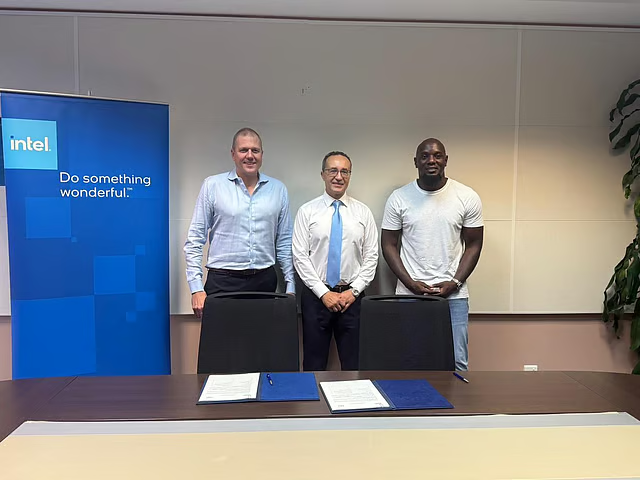
1. AIREV and Intel major AI partnership
AIREV and Intel announced a strategic partnership today. The collaboration focuses on personal AI computing. The companies aim to move AI away from the cloud. They want AI to live directly on personal computers. This move targets privacy concerns. It also targets performance limits. The partnership reflects a shift in AI design. AI now runs closer to users. AI becomes faster. AI becomes safer. AI becomes more personal. The companies shared details during a joint briefing. Industry experts welcomed the move. The announcement signals a new era in AI computing.
2. AI agents on Intel AI PCs
The new AI agents operate fully on Intel AI PCs. They do not depend on cloud servers. They do not send data outside the device. This change improves speed. It also improves security. Users gain full control. Enterprises reduce data risks. Personal users protect privacy. The agents handle tasks locally. They process language locally. They automate workflows locally. This design reduces latency. It also lowers internet dependence. The system works even offline. This marks a major leap in AI deployment.
3. Core AI operating system
AIREV brings its OnDemand platform to Intel hardware. OnDemand acts as an agentic AI operating system. It manages multiple AI agents. It assigns tasks automatically. It adapts to user behavior. The system works quietly in the background. It supports daily workflows. It supports business automation. It supports creative tasks. The OS coordinates agents smoothly. It improves productivity. It reduces manual effort. OnDemand transforms how PCs function. PCs become intelligent assistants. PCs respond to needs in real time.
4. Agentic AI shifts control
Agentic AI focuses on autonomy. Each agent acts independently. Each agent completes goals. The system decides actions. It learns patterns. It improves responses. Running agents on-device changes everything. Users avoid cloud delays. Companies avoid data leaks. Governments gain compliance control. Developers gain flexibility. This shift supports edge computing. It strengthens local intelligence. AI becomes personal again. The PC becomes the center of intelligence. This model challenges cloud-dominated AI.
5. Privacy and security drive
Privacy stands at the core of this launch. AI agents never leave the device. Sensitive data stays local. Businesses protect trade secrets. Users protect personal information. Governments meet data laws. The system reduces cyber risks. It removes third-party exposure. Intel hardware adds security layers. AIREV software enforces access control. Together they build trust. This matters in healthcare. This matters in finance. This matters in enterprise AI adoption. Security becomes a feature, not a concern.
 6. Intel AI PCs power
Intel AI PCs provide the foundation. These PCs include dedicated AI engines. They handle complex tasks efficiently. They balance performance and power. Intel designed them for AI workloads. The chips support neural processing. They accelerate on-device learning. They scale across users. The partnership unlocks full hardware potential. Software and silicon align. This synergy boosts performance. It reduces energy use. Intel positions AI PCs as future-ready machines.
7. Businesses gain faster
Companies benefit immediately. They reduce cloud costs. They reduce subscription fees. They automate workflows locally. AI agents handle emails. AI agents handle reports. AI agents handle scheduling. AI agents handle data analysis. All tasks stay internal. This improves efficiency. It cuts delays. It boosts productivity. Small businesses gain access. Large enterprises scale safely. AI becomes affordable. AI becomes practical. AI becomes part of daily work.
8. New AI possibilities
Developers gain new tools. They build agents for local systems. They avoid cloud restrictions. They customize workflows. They optimize performance. The platform supports modular design. Agents communicate efficiently. Developers control logic. They control data flow. This opens innovation. It encourages experimentation. It supports enterprise solutions. It supports consumer apps. The ecosystem grows quickly. Innovation shifts closer to users.
9. Turning point for AI PCs
Analysts call this a turning point. AI PCs move beyond hype. They deliver real value. On-device AI becomes mainstream. Experts predict rapid adoption. Privacy laws accelerate demand. Network limits increase relevance. Cloud fatigue grows. This model solves real problems. The partnership sets benchmarks. Competitors take notice. The AI PC category matures. The market enters a new phase.
10. Future of AI moves closer to users
The future of AI looks local. It looks private. It looks fast. AIREV and Intel lead this shift. AI agents become personal helpers. PCs evolve into smart partners. Users regain control. Businesses gain confidence. Technology becomes human-centered. This launch sets direction. AI no longer lives far away. AI lives on your PC. AI works for you.