Canada Rules Out China Free Trade Pact
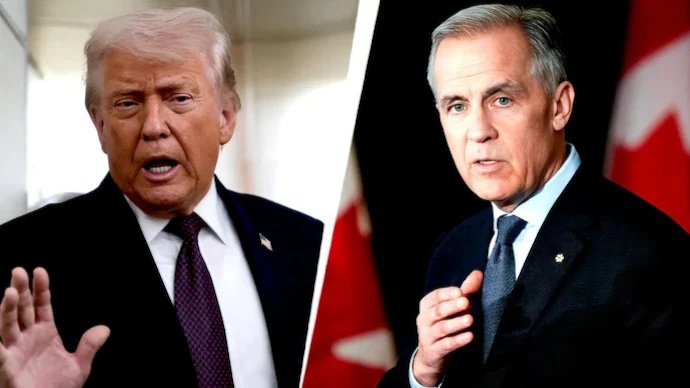
Canadian Prime Minister Mark Carney states his country will not seek a comprehensive free trade agreement with China. This declaration responds directly to a severe tariff threat from former U.S. President Donald Trump. The geopolitical tension highlights the delicate balance Canada maintains between its largest trading partner and the world’s second-largest economy.
Carney Clarifies Canada’s Position on China Trade
Prime Minister Mark Carney firmly closed the door on a broad free trade deal with China. He made this statement on Sunday, January 25. Carney emphasized Canada’s commitment to its existing trade agreements with the United States and Mexico. These agreements include specific commitments regarding nonmarket economies. Carney confirmed Canada has “no intention” of pursuing such a pact with China or any similar economy.
Trump’s Severe Tariff Warning to Canada
Former President Donald Trump issued a stark warning to Canada on social media. He threatened to impose a 100% tariff on all Canadian goods imported into the United States. This extreme measure would activate if Canada proceeded with a formal trade deal with China. Trump accused China of attempting to use Canada as a “Drop Off Port” to bypass U.S. tariffs. He framed the situation as China taking over Canada.
Details of the Limited Canada-China Tariff Understanding
Carney clarified the nature of his government’s recent engagement with Beijing. He described it as a limited agreement, not a sweeping free trade pact. This deal specifically aims to reduce tariffs on a few select sectors recently impacted by duties. The agreement seeks to rectify specific trade issues that emerged over the past two years. It is a targeted correction, not a foundation for a new comprehensive economic relationship.

Legal Obligations Under the US-Mexico-Canada Agreement
The Prime Minister referenced legal obligations under the United States-Mexico-Canada Agreement (USMCA). This modern trade pact includes clauses about dealings with nonmarket economies. Members must provide prior notification before pursuing free trade agreements with such nations. Carney’s statement aligns Canada’s public position with these treaty commitments. It reassures the United States of Canada’s adherence to the rules-based trade system they share.
Escalating Political Rhetoric Between Trump and Carney
The trade threat is part of a broader war of words between the two leaders. Trump recently commented that “Canada lives because of the United States.” Carney offered a sharp retort to this assertion. He positioned Canada as a global example that nations do not have to bend to autocratic tendencies. This exchange occurred alongside Trump’s controversial push to acquire Greenland, which strained NATO alliances.
Focus on Electric Vehicles and Agricultural Products
The practical core of the Canada-China arrangement involves electric vehicles and farm goods. Canada successfully negotiated lower Chinese tariffs on its agricultural exports. In return, Canada agreed to reduce its own tariffs on Chinese-made electric vehicles (EVs). Interestingly, Trump initially called this limited deal “a good thing.” He later reversed his position dramatically, leading to the severe 100% tariff threat against all Canadian imports.
Broader Implications for North American Trade and Politics
This confrontation places Canada in a challenging geopolitical position. The nation must navigate its crucial economic relationship with the United States while exploring other international opportunities. Carney’s firm rejection of a China FTA seeks to de-escalate immediate tensions with Washington. The situation underscores how U.S. domestic politics can directly pressure the trade policies of its closest allies. Canada’s strategy appears to favor stability in North America over a transformative deal with Beijing.