1. UAE President Reaffirms Commitment to a Modern Education System
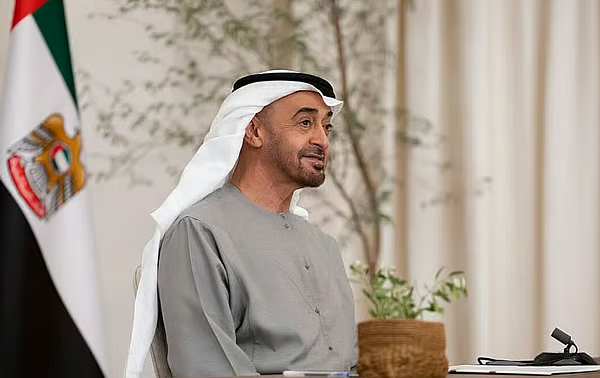
The President of the UAE has delivered a powerful message on education. His Highness Sheikh Mohamed bin Zayed Al Nahyan has reaffirmed his nation’s firm commitment. This commitment is to building a modern and forward-looking education system. He shared this vision on the occasion of the International Day of Education. This global day highlights the importance of learning for peace and development. The President’s statement outlines the strategic direction for the nation’s schools and universities. It signals continued investment in human capital for the future.
2. A Forward-Looking Vision for Education in the UAE
The President’s vision is explicitly forward-looking. It aims to prepare Emirati students for the world of tomorrow. This means moving beyond traditional rote learning methods. The system will integrate advanced technology and innovative teaching practices. It focuses on developing critical thinking and problem-solving skills. The goal is to create agile learners who can adapt to rapid global changes. This approach ensures the UAE’s youth are not just consumers of knowledge but creators of it.
3. International Day of Education: A Platform for Global and Local Reaffirmation
The International Day of Education provided the perfect platform. This UN-designated day emphasizes education as a human right. Sheikh Mohamed used it to align the UAE with global sustainable development goals. His statement connects national policy to worldwide educational aspirations. It shows the UAE as an active participant in the international dialogue on learning. The day served to reinforce local reforms within a universal framework of educational progress.
4. Key Pillars of the UAE’s Modern Educational Strategy
The modern education strategy rests on several key pillars. First is the integration of artificial intelligence and digital tools into all classrooms. Second is a strong emphasis on science, technology, engineering, and mathematics (STEM). Third is the cultivation of creativity, entrepreneurship, and ethical leadership. Fourth is ensuring inclusive and equitable quality education for all students. These pillars work together to build a comprehensive and resilient system for the 21st century.
5. Preparing Students for Future Economy and Job Markets
A core objective is direct alignment with the future economy. The curriculum is being designed to meet the needs of emerging industries. This includes sectors like renewable energy, space technology, and advanced healthcare. Students will gain skills in coding, data analysis, and robotics. The system prioritizes lifelong learning and continuous skill development. This ensures graduates are not only employable but are also pioneers in new fields.
6. Investment in Teachers, Technology, and Educational Infrastructure
The commitment is backed by substantial investment. The UAE is investing heavily in training and empowering teachers as mentors of innovation. Significant funds are allocated for cutting-edge educational technology and digital platforms. New school buildings are designed as collaborative and smart learning environments. This holistic investment covers human resources, digital tools, and physical infrastructure. It creates the ecosystem necessary for a transformative educational experience.
7. Fostering a Culture of Innovation and Research from School Level
The vision encourages a culture of innovation from an early age. Schools will promote research, experimentation, and project-based learning. Students will engage in national and international science fairs and competitions. Partnerships with tech companies and universities will provide real-world exposure. This culture aims to ignite curiosity and a passion for discovery. It builds a foundation for a knowledge-based and research-driven society.
8. Aligning Education with the UAE’s National Development Goals
The education system is a direct engine for national development. It is tightly aligned with the UAE Centennial 2071 plan and the Principles of the 50. The system aims to develop citizens who will lead the nation’s next phase of growth. It instills national values alongside global competencies. Education is treated as the most critical long-term investment for the country’s sustainability and prosperity. Every student is seen as a future contributor to the UAE’s story.
9. The Role of Public-Private Partnerships in Advancing Education
The government is actively fostering public-private partnerships. Leading local and international corporations are invited to contribute to curriculum design. They offer training programs, internships, and funding for special initiatives. These partnerships ensure education remains relevant to industry needs. They provide students with pathways from the classroom directly to impactful careers. This collaboration model is a hallmark of the UAE’s pragmatic approach.
10. The UAE’s Education Model as a Regional and Global Benchmark
Through this sustained commitment, the UAE aims to set a benchmark. Its education model is designed to be a reference point for the region and the world. It demonstrates how a nation can rapidly modernize its learning ecosystem. The focus on future-readiness offers lessons for other countries. As the President reaffirmed this vision, he positioned the UAE not just as a participant in global education but as a leading innovator shaping its future.